

Can AI Agents Take Comedians’ Jobs? What AI Comedy Means for Stand-Up
16 Oct, 2026 @Lana Hampicke
AI comedy and the jobs question: the short answer
AI comedy is coming for the writers’ room long before it comes for the stage. AI can already write a joke that a test audience rates as funny. It still cannot walk into a room of 2,000 strangers, read their mood and make them laugh together. That gap is where the comedian’s job survives, for now.
To test that answer, this article puts two very different voices side by side. Jimmy Carr is one of the most recognisable stand-ups in the world, famous for one-liners built with almost machine-like precision. Dario Amodei runs Anthropic, one of the companies building the AI agents that are changing white-collar work. Neither has written about AI comedy as a job threat in exactly these terms. But what each has said in public, set against the latest research, gives a sharp answer to the question every comic is now asking: can AI agents take comedians’ jobs?
Jimmy Carr on AI comedy: the room is the product
Carr’s view, pieced together from his recent long-form interviews, is that the joke was never the whole product. The room is.
On The Joe Rogan Experience in May 2025, Carr described live comedy as a shared experience the audience helps create, a kind of mind meld between performer and crowd. He contrasted the real joy of a live show with the “fake version” people consume online. On the same show he offered a darker take on AI itself: humans wanted a god, so they built one in their own image.
He returned to the theme on Trevor Noah’s podcast What Now? in September 2026. Summaries of that conversation describe Carr arguing that live performance is an antidote to digital isolation, and that technology is only an instrument whose output depends on the skill of the person using it. He also leaned on benign violation theory, the idea that we laugh when something feels wrong but safe.
Read together, these points make a clear case against AI comedy replacing the comedian:
- Comedy is co-created. The audience edits the show in real time; a model that cannot hear the room cannot do that.
- Live is scarce. The more content AI floods online, the more a real night out is worth.
- AI is a tool. In Carr’s framing, AI comedy is only as good as the comic steering it.
That last point matters. Carr is not saying AI can’t write jokes. He is saying a joke on a screen and a joke in a room are different products.
Dario Amodei on AI and jobs: why AI comedy writers should listen
Amodei has never claimed AI will replace stand-ups. His warning is broader, and that is what makes it relevant to AI comedy.
In a May 2025 interview with Axios, he said AI could wipe out half of all entry-level white-collar jobs and push unemployment to 10–20% within one to five years. He named technology, finance, law and consulting as the most exposed fields, and said AI companies and governments had to stop sugar-coating what was coming. He described a world where cancer is cured and the economy booms, yet a fifth of people are out of work.
Comedy is not on his list. But look at what his warning actually targets: entry-level, desk-based work that produces text to a brief. That describes a large share of paid comedy work that never touches a stage:
- punching up scripts and adverts
- writing jokes for hosts, presenters and corporate events
- churning out social captions, memes and topical one-liners
- first drafts of sketches and sitcom scenes
Amodei’s point is that this layer of work goes first, and it goes quietly. Companies stop posting the junior roles before anyone notices they are gone. For AI comedy, that means the first casualties are not headliners. They are the jobs where comedians used to learn their craft.
What the research says about AI comedy
The research splits neatly along Carr’s line between the page and the room. On short, written jokes, AI comedy already competes with humans. On a full stand-up voice, it still falls flat.
AI wins on the page. Psychologists Drew Gorenz and Norbert Schwarz at the University of Southern California tested ChatGPT 3.5 against people in a study published in PLOS ONE in July 2024. Its jokes were rated as funny as, or funnier than, jokes written by ordinary volunteers. In a second test, it wrote satirical headlines in the style of The Onion; student raters found them, on average, about as funny as the real thing. The authors warned this could pose a serious employment risk for comedy writers.
AI loses in the room. Google DeepMind ran the opposite experiment. Researchers led by Piotr Mirowski asked 20 professional comedians to write material with AI tools at a workshop in Edinburgh in August 2023. Most found the output bland and generic. One described it as 1950s cruise-ship material, only a little less racist. The comics said the models lacked context, personal experience and the edge good comedy needs. The researchers noted that safety filters also stop models from pushing boundaries, which is often where the laughs are.
The two studies are not in conflict. AI comedy is good at imitating a known format to a set brief. It is weak at having a point of view, and a point of view is what audiences buy tickets for.
Which comedy jobs AI comedy threatens first
Put Carr’s room test and Amodei’s entry-level warning together and a clear ranking appears. The closer a job is to a written brief, the more exposed it is; the closer it is to a live audience, the safer it is.
| Social captions, memes, brand jokes | High | Short, format-driven, produced to a brief; the PLOS ONE results apply directly |
|---|---|---|
| Corporate and advert copy punch-ups | High | Entry-level desk work of the kind Amodei warns about |
| Topical one-liners for hosts | Medium to high | AI matched Onion-style satire, but hosts still need a human filter |
| Sitcom and sketch first drafts | Medium | Useful for volume; DeepMind’s comedians found the output bland |
| Script editing and showrunning | Low to medium | Needs taste, voice and judgement across a whole story |
| Club and theatre stand-up | Low | Live, co-created with the audience, built on a personal point of view |
| Crowd work and improvisation | Very low | Depends on reading a specific room in real time |
The uncomfortable part is the career ladder. Many comedians paid the bills with the jobs at the top of this table while they learned stage craft at open mics. If AI comedy takes those first, the stage stays human, but fewer people can afford to get there.
The verdict: AI comedy takes the desk before the stage
Can AI agents take comedians’ jobs? Some of them, yes, and sooner than most comics expect. AI comedy will absorb the written, to-order work that Amodei’s warning describes. It will struggle with the live, shared moment that Carr says is the real product.
For working comedians, three moves follow:
- Double down on live. Crowd work, touring and specials are the hardest things for AI comedy to copy.
- Use AI as the intern, not the act. Let it draft premises, tags and admin; keep the voice and the edit human.
- Protect the ladder. If the paid writing gigs dry up, new comics need other routes to stage time, and venues and broadcasters will have to build them.
The joke may be cheap now. The room still isn’t.
What do you think: would you pay to see an AI do stand-up? Share this with a comedian and ask them.
SEO details for StoryChief
| Focus keyword | AI comedy |
|---|---|
| SEO title (55 characters) | Can AI Agents Take Comedians’ Jobs? AI Comedy Explained |
| Meta description (147 characters) | Can AI agents take comedians’ jobs? Jimmy Carr on live comedy, Dario Amodei’s job warning and new research on AI comedy, in one sharp guide. |
| Slug | ai-comedy-can-ai-agents-take-comedians-jobs |
| Secondary keywords | AI comedians, AI jokes, AI and stand-up comedy, will AI replace comedians, AI agents jobs, Jimmy Carr AI, Dario Amodei AI jobs |
| Category | Artificial Intelligence; Entertainment |
| Tags | AI comedy, stand-up comedy, AI agents, future of work, Jimmy Carr, Dario Amodei, comedy writing |
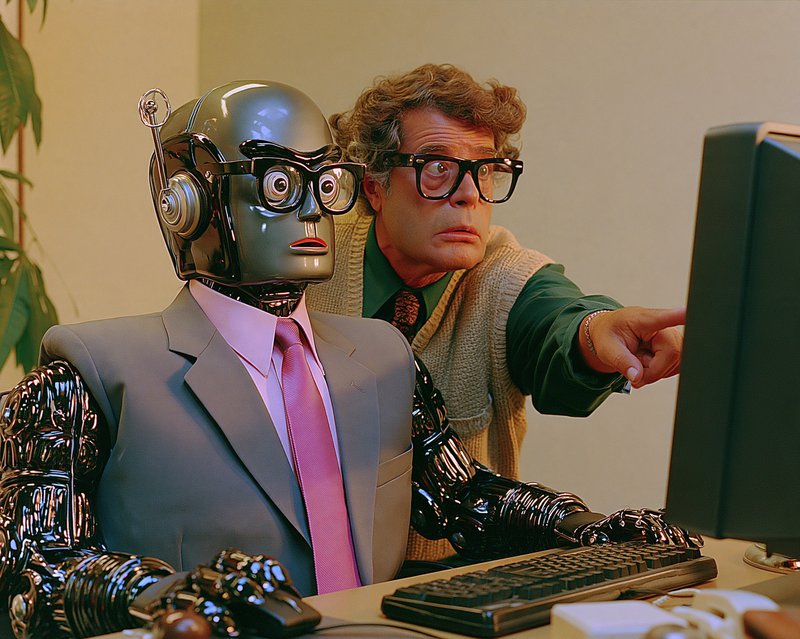
| Featured image alt text | A humanoid robot holds a human face mask while two people look on, illustrating AI comedy and whether AI agents can take comedians’ jobs |
| Social post | AI can already write jokes as funny as The Onion’s. So why are comedians still safe on stage? What Jimmy Carr and Dario Amodei’s views reveal about AI comedy. |
Sources
- Axios, Behind the Curtain: A white-collar bloodbath (May 2025)
- Fortune, Anthropic CEO warns AI could eliminate half of all entry-level white-collar jobs
- TechRadar, Are white-collar jobs at risk from AI? Anthropic CEO Dario Amodei certainly thinks so
- La Voce di New York, Anthropic CEO warns AI may kill millions of white-collar jobs
- Shortform, The Joe Rogan Experience #2326, Jimmy Carr: episode summary (May 2025)
- Rosetta, Jimmy Carr quotes, including “Jimmy Carr’s Hot Take on AI” (JRE Clips)
- Podwise, What Now? with Trevor Noah: Jimmy Carr episode summary (September 2026)
- Gorenz and Schwarz, How funny is ChatGPT? A comparison of human- and A.I.-produced jokes, PLOS ONE (July 2024); coverage via PsyPost and New Atlas
- Mirowski et al., A Robot Walks into a Bar: Can Language Models Serve as Creativity Support Tools for Comedy?, Google DeepMind (2024); coverage via Heise and Tech Xplore

Leave a Reply