
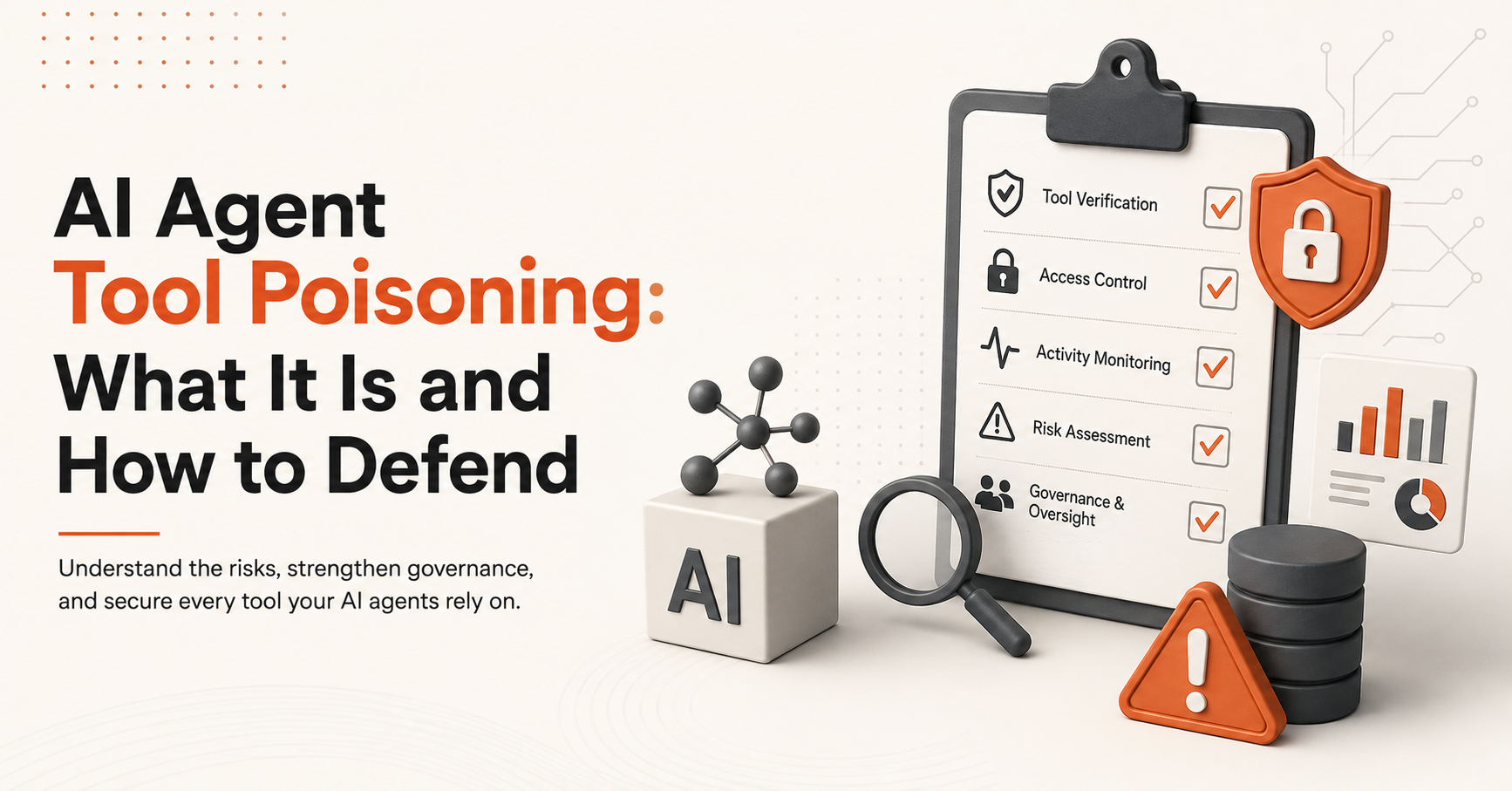
AI Agent Tool Poisoning: What It Is and How to Defend
Understanding AI agent tool poisoning helps security teams identify how attackers can manipulate connected tools and build stronger protection mechanisms before these risks impact business operations.
Creating secure AI environments requires organizations to look beyond the model itself, making sure every connected tool, plugin, and service is reviewed properly as part of a wider security and governance process.
Key Takeaways
- AI agent tool poisoning targets the external tools and services connected to AI systems.
- Compromised tools can influence AI outputs and business decisions.
- Security reviews and governance processes help reduce AI-related risks.
- Organisations should evaluate AI integrations before allowing them to access important systems.
- Strong oversight supports safer and more responsible AI adoption.
What is AI Agent Tool Poisoning?
AI agent tool poisoning occurs when attackers manipulate the tools, plugins, or external resources used by an AI agent. Instead of attacking the AI model directly, attackers target the connected systems that provide information or allow the AI agent to perform actions.
AI agents can integrate with various business applications, including:
- Customer databases
- Internal knowledge systems
- Business applications
- External APIs
- Automation platforms
If any connected tool contains false information, harmful instructions, or unauthorised changes, the AI agent may process that information and produce unsafe results.
This makes tool security an important part of AI risk management because AI systems depend heavily on the reliability of their connected resources.
How Does Tool Poisoning Happen?
The idea behind AI agents is to get information from various sources and execute tasks with the help of the available tools. An attacker may exploit this process by causing undesirable modifications in the systems that are connected.
A typical tool poisoning operation could be:
- A trusted tool/integration is compromised.
- Unwanted or false information or instructions are inserted.
- The AI agent accesses the affected resource.
- Unsafe outputs or unsafe actions are performed by the system.
These risks become greater when organisations use multiple third-party services without proper security reviews. This is closely linked with AI supply chain attacks, where vulnerabilities in external components create security concerns for the wider AI environment.
Why Tool Poisoning Creates Security Risks
AI agents often have access to business information and operational systems. A faulty connection can pose threats to data protection, decision making and compliance.
Potential risks include:
| Risk Area | Possible Impact |
| Data exposure | Sensitive information may be accessed or shared |
| Incorrect outputs | AI responses may contain unreliable information |
| Unauthorised actions | AI agents may perform tasks beyond approval |
| Business disruption | Critical workflows may be affected |
Organizations need to assess connected tools and have a robust AI governance framework in place to ensure oversight. Periodic audits enable the security teams to recognize vulnerabilities and enhance their security measures before they become issues.
How Organizations Can Defend Against AI Agent Tool Poisoning
Securing AI agents involves safeguarding models, AI tools and business processes. Clear controls should be established within organizations regarding access and usage of external resources by AI systems.
Security teams should consider:
- Checking all the tools that are linked to AI agents.
- Restricting permissions according to business requirements.
- Tracking the action and output of AI
- Regularly checking third party integrations
- Keeping track of AI systems and integrated services
An AI asset inventory helps organizations understand which AI systems, tools, and integrations are being used across the business. This visibility supports stronger governance and allows teams to identify potential risks more effectively.
Strengthening LLM Tool Security Through Governance
AI agents rely on various interdependent resources, requiring security teams to understand the interactions between these systems. Securing an AI application is not just about securing the model. Businesses must also have processes in place to track connected tools, oversight on permissions, and accountability.
Security of LLM tools can be enhanced by:
- Reviewing third-party tools before connecting them with AI agents
- Restricting access to other connected apps
- Keeping track of unusual AI behaviour
- Capturing AI changes in workflows
- Establishing response plans for security concerns.
A robust Enterprise AI governance approach enables businesses to ensure ownership and governance processes for AI systems. AI risk assessment services can also help security teams detect potential vulnerabilities and determine the need for further security measures.
The Role of Testing and Monitoring in AI Agent Security
AI systems may need to be reassessed when tools, data sources, or integrations are updated. Regular testing enables organisations to detect security issues early enough that they don’t affect business activities.
Testing processes can be used to review:
- AI agent behavior
- Connected tool permissions
- Data handling practices
- System responses
- Security vulnerabilities
AI model testing and assurance services enable organizations to assess AI systems and gain greater insights into their risks. Testing in conjunction with effective governance processes supports safer AI deployment and helps organisations align with regulatory requirements.
Best Practices for Preventing AI Agent Tool Poisoning
To prevent AI agent poisoning, organizations should establish clear practices for preparing and using AI agents.
Important steps include:
- Check all external tools before connecting it to an AI agent.
- Regularly check permissions to avoid unauthorized access.
- Be aware of unusual activity in relation to AI activities.
- Document AI processes and related resources.
- Train teams on secure AI usage.
Following these practices helps organisations strengthen Responsible AI adoption while maintaining better control over AI-powered workflows.
A structured governance process also aids in balancing out the automation and accountability for security teams. With the right investments in oversight, organisations can minimise risks and develop safer environments for AI adoption.
Final Thoughts
AI agents are changing how organisations automate tasks and interact with business systems. However, every connected tool introduces potential security concerns that require careful management.
Understanding AI agent tool poisoning helps organisations identify how attackers can target connected resources and why strong governance is essential. By reviewing integrations, monitoring AI activities, and ensuring transparent security measures, risks associated with contemporary AI environments can be minimized.
T3 helps organisations with enhanced visibility, risk assessment and oversight of AI systems. By creating robust AI processes now, businesses can be better prepared for future AI developments and stay more in control of their technology landscape.
Seeking to secure your AI agent domain? Partner with T3 to strengthen governance, evaluate AI risks, and create safer processes for managing connected AI tools.
FAQs
- What is AI agent tool poisoning?
AI agent tool poisoning is a security issue where attackers manipulate tools, plugins, or external resources connected to AI agents to influence their actions or outputs.
- How does tool poisoning affect AI agents?
AI agents may access wrong information, expose sensitive data or carry out actions that are not aligned with business requirements in the case of tool poisoning.
3. How are AI supply chain attacks connected to tool poisoning?
AI supply chain attacks involve risks introduced through external components, services, or integrations used by AI systems. Tool poisoning can occur when these connected resources are compromised.
- How can organisations protect AI agents from tool poisoning?
Organisations can improve protection by reviewing connected tools, limiting access permissions, monitoring AI activities, and implementing strong governance processes.
- Why is governance important for AI agent security?
Governance helps organisations define responsibilities, monitor AI usage, manage risks, and create security controls for AI systems throughout their lifecycle.
