
GDPR Article 22 & AI: Automated Decision-Making Oversight
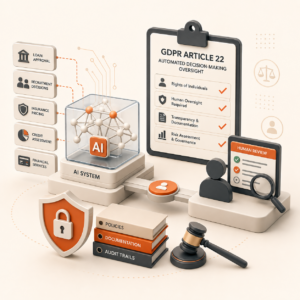
Ever clicked submit on an application only to receive an automated response within seconds? Artificial intelligence helps organisations process applications, detect fraud, assess financial risks, and support customer services faster than ever before. These automated systems can increase efficiency, but they can also have effects on decisions that impact people’s opportunities, finances and access to essential services. Understanding the legal responsibilities linked to these decisions is becoming increasingly important.
T3 Consulting experts offer businesses strategic guidance and implementation of AI governance strategies, including structured oversight, risk management, and governance protocols, which ensure responsible use of AI technologies. GDPR Article 22 AI has become an important consideration for organisations using automated systems to support or make decisions that have legal or similarly significant effects on individuals.
Understanding how this regulation applies can help organisations create fairer, more transparent decision-making processes while strengthening their compliance and governance efforts.
Key Takeaways
- GDPR Article 22 protects individuals from certain decisions made solely through automated processing.
- Organizations need to be aware of when AI-assisted decisions are considered to be under the scope of Article 22.
- Human oversight remains an important part of compliant AI governance.
- Governance processes and regular reviews help minimize regulatory risks.
- Good documentation helps to ensure transparency and future AI compliance.
What Is GDPR Article 22?
GDPR Article 22 gives individuals certain rights when decisions are made solely through automated processing and those decisions have legal or similarly significant effects. This rule is designed to protect people from decisions that are made without appropriate human involvement.
These are just a few scenarios in which Article 22 might be applicable:
- Loan approvals
- Recruitment decisions
- Insurance pricing
- Credit assessments
- Access to financial services
Understanding whether an AI system is making decisions independently or simply assisting human reviewers is an important part of regulatory compliance.
How Does GDPR Article 22 Apply to AI?
AI is deployed in many organizations for ranking applications, identifying abnormal activity, or suggesting actions to take. Article 22 does not automatically apply to every AI system The key question is whether the final decision is made solely by automated processing or whether a person genuinely reviews the outcome before it is confirmed.
| AI Process | Human Review | Article 22 Consideration |
| AI recommends candidates | Yes | Lower |
| AI automatically rejects loan applications | No | Higher |
| AI flags suspicious transactions | Yes | Lower |
| AI approves financial requests automatically | No | Higher |
Reviewing GDPR requirements for automated decision-making helps organisations identify where additional human oversight or safeguards may be needed.
Building Human Oversight Into AI Decisions
Human oversight is an important safeguard when AI supports decisions that affect individuals. AI suggestions should be reviewed, extra information should be taken into account, and decisions made at the discretion of the reviewer.
Organisations can enhance oversight through:
- Defining who can view AI-based decisions
- Noting the reasons behind important decisions
- Regularly track AI performance
- Adopting governance mechanisms that keep up with AI system changes
- Supporting employees with guidance over AI outputs
Many organisations also perform an AI risk assessment to understand where stronger controls may be required before AI systems are introduced into business operations.
How Organisations Can Prepare AI Systems for GDPR Article 22 Compliance
Preparing AI systems for GDPR requirements starts with understanding where automated decisions are being used and how they affect individuals. Organisations need to assess their AI processes prior to deployment to assess the potential for issues and then set the appropriate oversight in place.
The following are key steps to preparation:
Locate AI decision-making processes: Determine the areas where AI systems are making decisions and what their contribution is in business processes.
Record information consumption: Keep transparent log of the information passed through AI systems and its utilization.
Define accountability: Assign responsible teams or individuals who can review AI decisions and manage governance activities.
Develop review protocols: Develop methods for reviewing AI-generated content and dealing with instances where human intervention is needed.
Maintain transparency: Ensure users understand when AI systems are involved in decisions that affect them.
Understanding AI systems can aid in good governance and enable organisations to create processes in line with the AI compliance GDPR requirements. Documentation, oversight, and periodic review all contribute to building a robust framework for responsible AI usage.
Steps to Improve AI Governance and Compliance
Managing AI effectively requires more than understanding regulations. Organisations also require governance mechanisms that enable transparency and accountability.
Key actions include:
- Recognize AI systems in business decision making.
- Keep an asset inventory of AI for better visibility:
- Assign ownership for AI systems
- Provide documentation of governance and review processes
- Keep track of the performance of AI and its regulatory requirements
Structured AI Governance provides a framework for developing consistent oversight and a stronger approach to AI risk management throughout the organisation.
Common Challenges Organisations Face
Many businesses are still developing governance processes for AI systems, making compliance more challenging as AI adoption grows.
Common challenges include:
- Understanding when Article 22 applies
- Dealing with third-party AI services
- Showing true human control
- Ensuring governance records are kept up to date
- Preparing for changing AI regulatory compliance expectations
Services such as AI model testing and assurance can help organisations evaluate AI systems before they are used in important decision-making processes.
Building Long-Term AI Governance
Good governance is established by regular inspections, accountability and accurate record keeping. Organisations that establish governance early are better prepared as regulations and AI technologies continue to evolve.
Establishing Enterprise AI governance promotes visibility into AI systems and promotes Responsible AI adoption throughout the organisation. Businesses may also benefit from AI governance consulting to strengthen oversight processes and align governance activities with business objectives.
Final Thoughts
Artificial intelligence is changing how organisations make decisions, making governance and transparency more important than ever. Understanding GDPR Article 22 AI helps businesses identify where human oversight is needed and how governance processes can support fair and accountable decision-making.
Building stronger governance, maintaining accurate documentation, and reviewing AI systems regularly all contribute to better AI compliance GDPR. T3 supports organisations in enhancing AI governance by providing better visibility, evaluation and monitoring of AI systems.
Looking to strengthen your AI governance strategy? Learn about how T3 can help your organisation develop governance structures that facilitate compliant, transparent, and responsible use of AI for decision-making.
FAQs
1. What is GDPR Article 22?
GDPR Article 22 gives individuals certain rights when decisions are made solely through automated processing and those decisions have legal or similarly significant effects.
2. Does GDPR Article 22 apply to every AI system?
No. It generally applies when decisions are made entirely through automated processing without genuine human involvement.
3. What is automated decision-making under GDPR?
Automated decision-making refers to decisions made by technology without meaningful human review when those decisions significantly affect individuals.
4. Why is human oversight important for AI?
Human oversight helps review AI-generated outcomes, identify errors, and ensure decisions are fair, transparent, and accountable.
5. How can organisations improve AI governance?
Organisations can strengthen governance by maintaining AI inventories, assigning ownership, reviewing AI systems regularly, documenting decision processes, and performing appropriate governance and risk reviews.
