
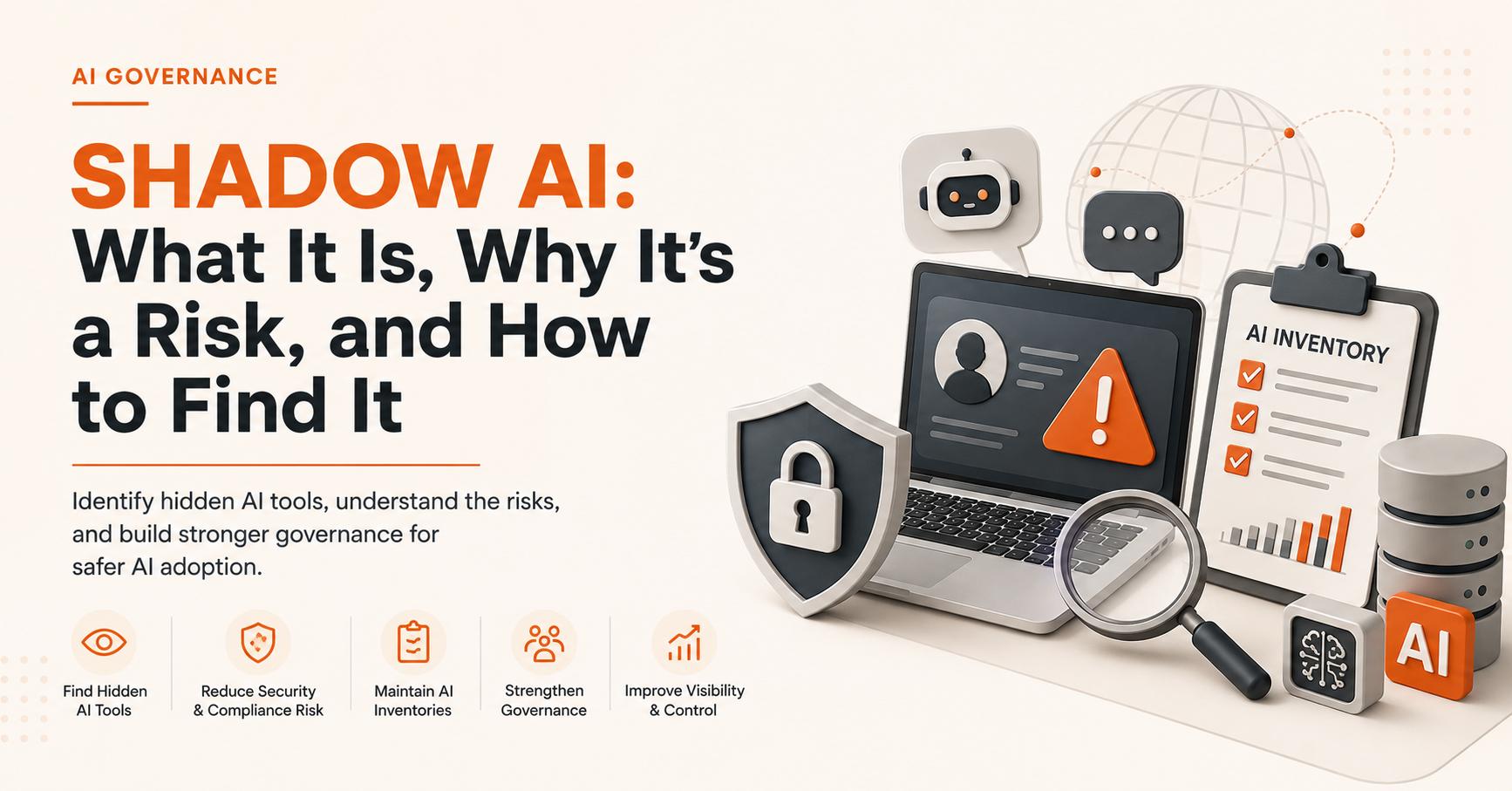
Shadow AI: What It Is, Why It’s a Risk, and How to Find It
Every day, employees use AI tools to write documents, analyse information, generate code, and complete tasks faster. Many of these applications are adopted without formal review from IT, security, or governance teams. When teams use unapproved AI platforms or external machine learning tools without proper oversight, they create Shadow AI within the organisation.
The rapid adoption of AI can make it difficult for businesses to maintain visibility into where these tools are being used and what information they process. T3 helps organisations identify hidden AI workflows and establish stronger governance practices that improve control and transparency.
Finding unapproved AI applications early on allows businesses to manage potential risks while creating a more structured environment for AI adoption.
Key Takeaways
- Shadow AI occurs when workers leverage AI technologies without proper authorization or control.
- The use of AI without proper authorization may pose security, privacy, and compliance risks.
- Effective AI governance begins with identifying all AI systems across the organisation.
- Effective governance procedures allow businesses to better manage their AI systems.
- Regular reviews and documented AI inventories support safer AI adoption.
What Is Shadow AI?
Shadow AI is defined as the AI applications, platforms or services used that are outside of the approved organizational processes. These tools can be used by employees to boost their productivity or finish tasks faster, but they may not be aware of the broader effects on business.
Examples include:
- AI writing assistants
- AI coding tools
- AI meeting transcription software
- Public chatbot platforms
- AI-powered automation tools
Shadow IT is about technology that may gain traction and become commonplace before the governance teams realize it exists.This can make it difficult to understand how data is collected, used, and shared.
Why Is Shadow AI Becoming More Common?
Anyone with an internet connection can use AI tools and so it’s even easier to adopt them. There are also many employees who just want to work more efficiently, and it’s typically quicker to implement AI than internal governance processes.
Common reasons include:
- Easy access to free AI applications
- Lack of internal AI usage policies
- Staff investigating other forms of technology on their own
- Different departments often use different AI tools.
- Limited visibility into AI adoption across teams
Creating an AI governance framework provides clear guidance on the responsible use of AI and promotes consistent practices across the organisation.
What are the most significant risks of AI shadowing?
Every organization should understand the possible Shadow AI risks before expanding AI usage across the business.
| Risk Area | Why It is Important |
| Data privacy | Sensitive information may be shared with external AI tools. |
| Security | Unapproved platforms may introduce security concerns. |
| Compliance | AI usage may conflict with internal policies or regulations. |
| Visibility | Leadership may not know which AI tools employees are using. |
| Decision quality | AI-generated outputs may require human review. |
Examining these areas allows for improved AI risk management and helps organizations identify any further controls required.
How to Discover Shadow AI?
The only way to spot hidden AI tools is to understand how your employees work and what technologies they use on a daily basis.
Helpful steps include:
- Monitor software and application usage of departments.
- Discuss the AI tools being used across the organisation with the relevant teams.
- Maintain an AI asset inventory that records approved AI systems.
- Identify third-party tools that connect to organisational data.
- Keep governance documents up to date with the introduction of the new AI tools.
Some organizations also use AI risk assessment activities to evaluate how AI systems interact with business processes and sensitive information.
How AI Governance Helps Reduce Risk
Finding AI tools is only the beginning. There’s a need for processes to ensure the monitoring of AI systems over time and informed decision-making.
Good governance can be achieved by means of:
- Streamline governance of new AI tools
- Established clear ownership of AI systems.
- Regular inventory reviews
- Guidance for employees regarding approved use of AI tools.
- Regular security and compliance audit.
These activities help organisations understand their AI environment, establish clear accountability, and maintain effective oversight.
Services such as AI model testing and assurance can also help organizations evaluate AI systems before they are adopted more widely.
Building a Strong Foundation for Enterprise AI Governance
Identifying the tools across an organisation is not enough to manage AI usage. Organizations need clear guidelines and protocols in place to help their employees understand how to choose, use, assess, and track AI systems. A governance model will offer improved visibility and facilitate organizations to properly manage AI operations across departments.
A robust governance process can help organisations to:
- Test AI applications prior to deployment
- Monitor changes throughout AI systems
- Maintain records to support compliance.
Enterprise AI governance provides a consistent approach to managing AI across the organisation, helping teams apply the same policies, processes, and controls. It enables businesses to strike a balance between innovation and the necessary controls to ensure safe use of AI.
Establishing clear guidelines and encouraging collaboration between technical, business, and compliance teams supports Responsible AI adoption and builds trust in the use of AI. The strong governance structure allows businesses to manage future AI development and more effectively manage the systems.
Building Better Visibility Across Your Organization
Without organizations being able to observe the AI systems, they cannot manage them. Developing explicit documentation, reviewing new applications of AI, and refining governance procedures are all ways to limit ambiguity regarding AI usage.
The path forward is to seek visibility rather than restrictions when it comes to detecting Shadow AI in organizations for businesses. While it is not necessary for all employees to have access to AI, it can work best when it is easily accessible to employees when it has been implemented.
With proper documentation, and an AI compliance program like AI compliance services, organizations can gain an understanding of how much AI is in use and how it can be integrated into business policies.
Final Thoughts
AI tools are becoming part of everyday business activities, making visibility more important than ever. The detection of hidden AI systems enables organizations to enhance governance, security measures, and decision-making processes.
Over time, business risks can be minimized through the creation of an inventory of AI systems, a review of new applications, and the establishment of clear governance processes. Effective management of Shadow AI provides organizations with visibility into the use and helps develop more effective controls related to AI adoption.
T3 supports organizations in building stronger governance practices that improve visibility into AI usage while helping teams manage AI risks with greater confidence. Explore how T3 can help your organization create a stronger AI governance strategy and establish better oversight across your AI environment.
FAQs
1. What is Shadow AI?
Shadow AI refers to AI tools or applications that are deployed within an organization without proper authorization and governance from the IT or security or governance team.
2. Why is Shadow AI considered a business risk?
Inappropriate use of AI tools can pose privacy risks, compliance issues, and make it hard to keep track of AI usage throughout the company.
3. How can organizations identify Shadow AI?
AI can be identified within organizations by reviewing the use of the apps, speaking with different department teams, running AI inventories of the organization’s applications, as well as monitoring software adoption.
4. How is Shadow AI different from Shadow IT?
Shadow IT refers to the use of technology that’s not authorized or supported by the organization, while Shadow AI is specifically regarding AI-driven applications and services.
5. What is the first step in managing Shadow AI?
The key first step is to establish visibility by discovering and documenting existing AI tools, leveraging governance and inventory processes.
