

How to Risk-Tier Custom AI Agents Under ISO 42001
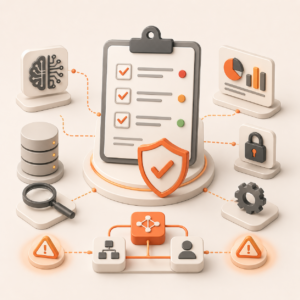
T3 helps organizations strengthen AI governance by assessing AI risks, improving oversight, and creating clearer controls around AI systems. Risk-tiering custom agents gives teams a way to understand which systems need basic safeguards and which require stronger testing, monitoring, and human review.
Key Takeaways
- AI agents should be assessed based on their actions, access, data, and potential impact.
- ISO 42001 supports a structured process for identifying and treating AI-related risks.
- Low, medium, and high-risk tiers can help teams decide how much control an agent needs.
- An AI risk registry can document each agent, its risks, and the controls applied.
- Risk tiers should be reviewed when an agent’s purpose, permissions, data, or tools change.
Why Custom AI Agents Need Risk-Tiering
A simple chatbot that answers internal questions does not carry the same level of risk as an agent that can approve payments or modify customer records. Giving both systems the same risk rating could leave important gaps in governance.
Risk-tiering should consider factors such as:
- Autonomy: How much can the agent do without approval?
- Data access: Does it handle public, internal, personal, or confidential information?
- Tool access: Can it connect to databases, APIs, financial systems, or other applications?
- Business impact: What could happen if the agent makes a wrong decision?
- Human involvement: Can a person review, approve, or stop important AI actions before they are carried out?
An AI Inventory can help organizations identify which agents exist, who owns them, what systems they connect to, and where they are being used.
What Does ISO 42001 Risk Assessment Involve?
ISO/IEC 42001 specifies requirements for the establishment, implementation, maintenance, and improvement of an AI management system. The risk process included in ISO/IEC 42001 helps organizations identify, assess, and address AI-related risks. It also helps organizations select appropriate controls based on the risks identified.
In the case of AI agents, the risk assessment must focus on the overall system as opposed to just the underlying model.
Teams can review:
- The agent’s purpose and users
- Data collected and processed
- Connected applications and tools
- Possible security threats
- Potential harm to people or the business
- Existing safeguards
- Remaining risk after controls are applied
How to Create Low, Medium, and High-Risk Tiers
Organizations can create their own risk categories based on their business context and assessment results. ISO 42001 does not prescribe a universal low, medium, or high classification system for every AI agent.
| Risk tier | Typical characteristics | Example controls |
| Low | Limited data and simple tasks | Access controls, logging, basic testing |
| Medium | Sensitive data or business actions | Stronger testing, monitoring, human review |
| High | High autonomy or significant business impact | Formal approval, extensive testing, strong human oversight |
The goal is to connect the level of risk with the level of control. This makes risk-tiering AI agents more useful than giving every system the same set of requirements.
Build an AI Risk Registry for Every Agent
Once agents have been assessed, their details should be recorded in a central AI risk registry. This gives governance and security teams a clear record of how each system is being used.
Useful fields can include:
- Agent name and owner
- Purpose and intended users
- Data sources
- Connected tools and APIs
- Level of autonomy
- Risk tier
- Identified risks
- Existing controls
- Human review requirements
- Residual risk
- Next review date
This record can also support audits and help teams track changes over time.
Match ISO 42001 Controls to the Risk Level
Agents that carry higher levels of risk need more stringent control measures. Controls must be chosen depending on the risk assessment and treatment strategy of the organization and not all controls need to be employed in each case.
The relevant controls for ISO 42001 might include controls in the fields of data, security, system development, human involvement, performance, and responsible AI.
A strong AI compliance framework should connect these controls to clear owners, testing requirements, evidence, and review dates.
How Human Oversight Changes Agent Risk
Human involvement can play an important role when an AI agent can perform sensitive or high-impact actions.
AI human oversight can take different forms:
- A person approves every important action.
- A person reviews selected decisions.
- A person monitors activity and can intervene when needed.
- The agent works independently within defined limits.
The right level depends on the consequences of an error. An agent handling routine internal requests may need less intervention than one managing financial or customer decisions.
Data Quality Should Be Part of the Assessment
An agent may be highly secure but deliver low performance because its data may not be up-to-date or properly managed.
The scope of an AI Data Foundation includes topics like data ownership, data quality, data access, data security, and data suitability. Data risks should form part of the wider assessment rather than being reviewed separately.
When Should an AI Agent Be Re-Tiered?
A risk rating should be reviewed when an agent changes significantly.
Common triggers include:
- New APIs or tools
- Wider data access
- A new business purpose
- More autonomous actions
- A new model version
- New user groups
- Security incidents
- Changes in regulatory requirements
Regular reassessment supports stronger AI risk management and helps ensure controls match the agent’s current capabilities.
Ready to Build Stronger Controls for Your AI Agents?
Custom AI agents can do useful tasks across business systems, but their growing autonomy also presents new governance challenges. Risk-tiering provides a clearer way for organizations to identify which agents need basic safeguards and which require more robust controls, testing and human review.
A well-documented ISO 42001 risk assessment can connect identified risks with appropriate treatment and controls while supporting responsible AI adoption. T3 helps organizations strengthen AI governance, risk assessment, and oversight as they develop and manage AI systems.
Frequently Asked Questions
1. Does ISO 42001 define specific risk tiers for AI agents?
No. Organizations can establish risk categories that fit their own context, assessment method, and risk tolerance.
2. What should be included in an AI agent risk assessment?
It should consider the agent’s purpose, autonomy, data, tools, users, potential impacts, existing controls, and remaining risks.
3. Are high-risk AI agents always prohibited?
No. A higher risk rating generally means stronger safeguards, testing, oversight, and approval may be required.
4. How often should AI agents be reassessed?
There is no single schedule that fits every organization. Reassessment should occur when significant changes affect the agent’s purpose, capabilities, data, access, or risk profile.
5. Why is human oversight important for AI agents?
Human oversight can provide a control point for actions that could cause significant financial, operational, legal, or personal consequences.

Leave a Reply