

AI Model Registry vs AI Inventory: What’s the Difference?
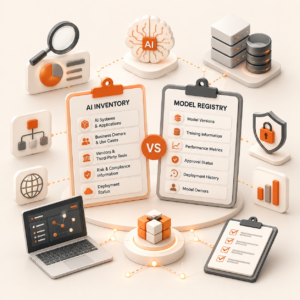
A company can have dozens of AI models on record and still have little visibility into the other AI tools being used across the business. Teams may use chatbots, AI agents, third-party platforms, internal models, and AI features built into business software. This makes it harder to understand the full AI environment and manage related risks.
T3 helps organizations improve AI governance through better visibility, risk management, and oversight of AI systems. Understanding ai model registry vs ai inventory helps businesses see why these two records serve different purposes and how they can work together.
An inventory gives a wider view of AI use across an organization, while a model registry focuses more closely on individual models and their lifecycle.
Key Takeaways
- An AI inventory provides a broad view of AI systems, tools, and use cases.
- A model registry focuses on models, versions, ownership, and lifecycle information.
- A model registry does not replace an organization-wide AI inventory.
- Using both can improve risk tracking, governance, and audit preparation.
- Connecting these records can give teams better visibility across the AI lifecycle.
What Is an AI Inventory?
So, what is an ai inventory? It is a central record of the AI systems used across an organization. It can include internally developed models, third-party AI applications, AI agents, copilots, APIs and embedded AI features in business software.
An AI inventory might contain:
- Name of AI system and purpose
- Business owner, technical owner
- Vendor or supplier
- Business Case
- Risk stratification
- Regulatory regulations
- Deployment state
This broader perspective allows organizations to see where AI exists and who is responsible for it. An AI inventory of assets can also help governance teams identify systems that need further review.
What Is a Model Registry?
A model registry is a centralized repository for managing machine learning and AI models throughout their lifecycle. It can store information on model version , test, approval, deployment and ownership .
The model registry definition is helpful here because a registry is intended for managing specific models, not for documenting all artificial intelligence systems across an organization.
A ML model registry can help technical teams track:
- Model variants
- Information on training
- Results of performance
- Approval status
- History of Deployment
- Owners of models
- Test data
This allows data science and engineering teams to better understand what happened to a model when it went from development to production.
AI Model Registry vs AI Inventory: Key Differences
The two systems overlap in some areas, but their goals are different.
| Area | AI Inventory | Model Registry |
| Main purpose | Organization-wide AI visibility | Model lifecycle management |
| Scope | Broad | Model-focused |
| AI applications | Included | Usually outside the main focus |
| Third-party AI | Can be recorded | May not be included |
| Model versions | May reference them | Detailed tracking |
| Risk information | Usually included | Can be included |
| Business use cases | Included | May be linked |
| Deployment history | May be recorded | Usually tracked in detail |
The primary difference is scope. An inventory looks across the organization’s AI landscape, while a registry provides deeper records for individual models.
Why Organizations Need Both
Choosing between the two can create gaps in visibility. A model registry can provide excellent information about internally developed models while leaving third-party AI applications outside the record.
An organization-wide inventory can identify these wider systems, while the registry provides deeper technical information for models that require detailed lifecycle tracking.
Together, they can support Enterprise AI governance by connecting business use cases with technical model records.
How AI Inventory and Model Registry Support Compliance
Regulated organizations need clear records showing how AI systems are used, who owns them, and how risks are handled. AI governance compliance tools can help teams organize information needed for reviews, reporting, and audits.
An AI risk assessment can help classify systems based on their use and potential impact. A clear AI governance framework can then define which systems require testing, approval, monitoring, or additional controls.
This can also help organizations address changing AI compliance requirements without keeping governance records in separate places.
How to Connect an AI Inventory With a Model Registry
The two records can work together as part of a wider AI lifecycle.
A useful flow is:
Discover → Inventory → Classify → Assess Risk → Register Model → Test → Approve → Deploy → Monitor
For models requiring deeper review, AI model testing and assurance can provide evidence about performance, safety, and reliability before deployment.
Teams can also use AI risk management processes to review whether a model’s risk level changes when its purpose, data, or deployment environment changes.
Common Mistakes to Avoid
Organizations can run into problems when they treat one system as a replacement for the other.
- Using a model registry as the complete AI record
- Leaving third-party AI tools out of the inventory
- Failing to assign system owners
- Tracking models without their business use cases
- Keeping outdated records
- Separating governance information from technical records
Keeping these records connected supports Responsible AI adoption and gives teams a clearer view of how AI is being used.
Final Thoughts
An AI inventory and model registry solve different problems. The inventory provides broad visibility across AI systems, applications, tools, and use cases, while the registry provides deeper information about individual models and their lifecycle.
T3 helps organizations build stronger AI governance practices through visibility, risk assessment, and oversight. Bringing inventory and model registry data together can give teams a clearer foundation for governance, security, and compliance.
Want to bring greater visibility to your AI environment? T3 can help your organization strengthen AI governance, improve risk oversight, and build clearer records across the AI lifecycle.
FAQs
1. What is the difference between an AI inventory and a model registry?
An AI inventory provides broad visibility into AI systems across an organization. A model registry focuses on managing individual models, their versions, testing, approvals, and deployment history.
2. Can a model registry replace an AI inventory?
No. A model registry generally has a narrower focus and may not capture third-party AI applications, AI agents, copilots, or other systems used across the business.
3. What should an AI inventory include?
It can include AI systems, use cases, owners, vendors, data sources, risk levels, deployment status, and regulatory information.
4. What information should a model registry track?
A model registry can track model versions, owners, training details, performance results, testing records, approvals, and deployment information.
5. Do regulated organizations need both?
Organizations with broad AI use may benefit from both. The inventory provides organization-wide visibility, while the registry gives technical teams deeper control over individual models.

Leave a Reply